
The craft of persuasive speech has fascinated scholars since ancient times, with roots tracing back to the Romans (such as Cicero in De Oratore) and the Greeks (notably Aristotle and Plato). Aristotle, in particular, provided a foundational approach to rhetoric, laying out strategies that remain influential.
In his text Rhetoric, he detailed key principles that continue to help writers craft convincing arguments. Here, we blend Aristotle’s insights with techniques from The Elements of Eloquence, another invaluable text on eloquent, persuasive writing.
- Use Logical Appeals
Aristotle’s notion of logos emphasizes reason as the bedrock of persuasion. By relying on data, facts, and clear examples, you create a structured argument that appeals to logic, drawing your audience towards a reasoned conclusion. This approach establishes credibility and helps avoid common pitfalls. Techniques from The Elements of Eloquence can enhance logos: consider using antithesis to highlight contrasting points and keep your argument dynamic and engaging. - Incorporate Syllogism
Classical rhetoric often employs syllogism, where two premises naturally lead to a conclusion. For instance, “All plants need sunlight, and roses are plants, therefore, roses need sunlight.” This deductive approach keeps your argument logically airtight. The book The Elements of Eloquence suggests combining syllogism with epiphora, repeating the last word or phrase of successive sentences to reinforce the conclusion powerfully. - Steer Clear of Logical Fallacies
Aristotle warned against the pitfalls of epideictic oratory, which sometimes relies on an emotional “praise-and-blame” approach. While such appeals can be powerful, they risk diluting the argument’s logic with pure emotion. The Elements of Eloquence also advises using asyndeton (omitting conjunctions) to streamline thoughts, keeping your argument logically cohesive and avoiding overstatement. - Weave Emotional Appeal with Pathos
Aristotle also highlighted pathos, the appeal to emotions. Logical arguments are powerful, but emotion moves audiences at a deeper level. Public figures like Martin Luther King, Jr. mastered pathos in both speech and writing, blending it seamlessly with logos. In The Elements of Eloquence, techniques like anaphora (repeating initial words in successive sentences) and hyperbole can amplify pathos, creating rhythm and resonance that draw listeners in emotionally. - Employ Ethical Appeal (Ethos)
Aristotle’s ethos is about building trust. Establishing yourself as a knowledgeable, ethical person invites your audience to connect with you and trust your insights. When crafting an argument, sharing your experience or beliefs can create a strong foundation. In The Elements of Eloquence, using polysyndeton (repeating conjunctions) can help emphasize sincerity and earnestness, lending depth to the ethical appeal. - Use Rhetorical Devices for Emphasis
Figures of speech, commonly used in English rhetoric, add stylistic flair. Repetition with anaphora (like Winston Churchill’s “We shall fight…”) or epiphora creates rhythm and reinforcement, while rhetorical questions transform statements into thought-provoking questions. The Elements of Eloquence also suggests chiasmus (mirrored structure) as a tool to present balanced arguments, which can create memorability and a sense of completeness.
By blending Aristotle’s timeless advice with the rhetorical devices detailed in The Elements of Eloquence, you can craft persuasive, impactful content that resonates logically, emotionally, and ethically.

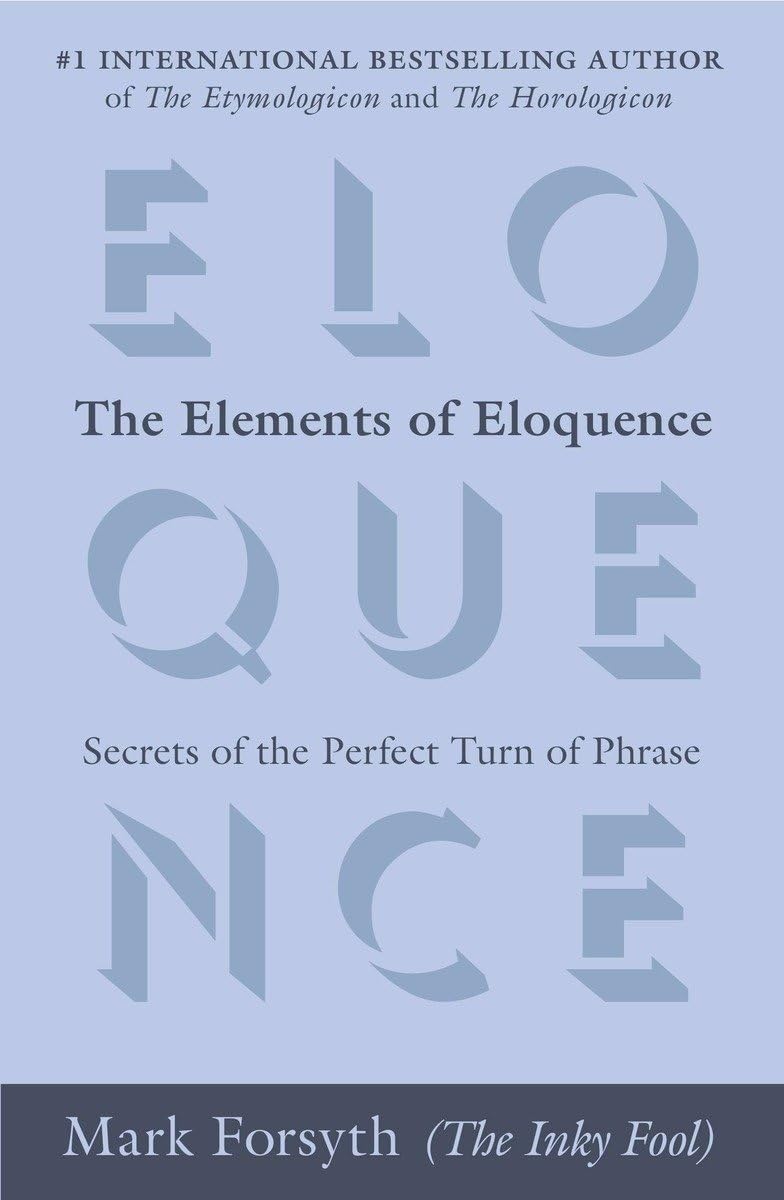
“The Elements of Eloquence” by Mark Forsyth
Mark Forsyth delves into the art of crafting beautiful, memorable language, especially within the English language. Forsyth breaks down classic rhetorical devices, illustrating how they can be used to give writing a poetic, persuasive, and powerful edge.
Here’s a summary of the significant elements and rhetorical devices that Forsyth discusses:
1. Alliteration
- Definition: Repetition of the initial consonant sounds of words close together.
- Effect: Creates rhythm, enhances memorability, and can make phrases more pleasant or striking. For example, “Peter Piper picked a peck of pickled peppers.”
2. Polyptoton
- Definition: Repeating the same root word with different endings or in different forms.
- Effect: Adds complexity and depth by showing different aspects of a concept. For instance, “Absolute power corrupts absolutely.”
3. Antithesis
- Definition: Juxtaposing two contrasting ideas in a balanced structure.
- Effect: Highlights differences and creates a sharp, memorable statement. Classic example: “It was the best of times, it was the worst of times.”
4. Parataxis
- Definition: Listing clauses or phrases without conjunctions.
- Effect: Makes writing feel fast-paced and impactful, giving a straightforward, almost blunt effect. An example would be Julius Caesar’s famous line: “I came, I saw, I conquered.”
5. Hypotaxis
- Definition: Using subordinate clauses to add layers of meaning and complexity.
- Effect: Provides depth and sophistication, drawing readers into a more complex thought or narrative.
6. Anadiplosis
- Definition: Repetition of the last word of a clause at the beginning of the next clause.
- Effect: Creates a rhythmic link between ideas and can build intensity. For example: “Fear leads to anger. Anger leads to hate. Hate leads to suffering.”
7. Chiasmus
- Definition: Reversing the structure of a phrase in subsequent clauses.
- Effect: Adds symmetry and elegance. Famous example: “Ask not what your country can do for you—ask what you can do for your country.”
8. Epistrophe
- Definition: Repetition of the same word or phrase at the end of successive clauses.
- Effect: Reinforces a concept or emotion, often building intensity. For example: “For no government is better than the men who compose it, and I want the best, and we need the best, and we deserve the best.”
9. Tricolon
- Definition: A series of three parallel elements.
- Effect: Makes statements more complete and satisfying. For example, “Life, liberty, and the pursuit of happiness.”
10. Hyperbaton
- Definition: Changing the normal order of words.
- Effect: Draws attention to particular words and can create a poetic or elevated tone. For instance, “This I must see.”
11. Isocolon
- Definition: Using phrases or clauses of equal length and structure.
- Effect: Creates rhythm and balance. A well-known example: “Veni, vidi, vici” (“I came, I saw, I conquered”).
12. Epanalepsis
- Definition: Repeating the initial word or phrase at the end of the same clause or sentence.
- Effect: Creates a feeling of completion and often emphasizes the repeated term. For example, “The king is dead; long live the king.”
13. Aporia
- Definition: Expressing doubt or uncertainty.
- Effect: Engages the reader by presenting a question or concern. Often used to give the impression of contemplation or honesty.
14. Anaphora
- Definition: Repetition of a word or phrase at the beginning of successive clauses.
- Effect: Emphasizes an idea or theme and often makes speeches or texts feel more powerful and rhythmic. Famous in Martin Luther King Jr.’s “I have a dream” speech.
15. Personification
- Definition: Assigning human qualities to inanimate objects or abstract ideas.
- Effect: Makes abstract concepts more relatable and vivid, enhancing imagery.
16. Metonymy & Synecdoche
- Definition: Using a part of something to represent the whole (synecdoche) or an associated concept (metonymy).
- Effect: Adds layers of meaning and can make descriptions more impactful.
17. Pleonasm
- Definition: Using more words than necessary to convey meaning.
- Effect: Adds emphasis or a certain grandiose style, often found in rhetorical speeches or emotional writing.
18. Euphemism
- Definition: Using mild or indirect language to express something harsh or unpleasant.
- Effect: Softens the message and can convey politeness or tactfulness.
19. Litotes
- Definition: Using understatement by negating the opposite.
- Effect: Adds subtlety and sometimes irony, such as saying “not bad” instead of “good.”
20. Zeugma
- Definition: Using a single word, usually a verb or an adjective, to modify two other words, in a way that applies differently to each.
- Effect: Adds wit or surprise by combining disparate elements, as in “He took his hat and his leave.”
These devices are some of the essential tools Forsyth explains, showing how they’ve been used in literature and rhetoric throughout history to enhance the beauty, impact, and memorability of language. Each device, when used thoughtfully, can add flair, elegance, and persuasive power to writing.

Celina brings a wealth of experience to Hiddennumerology as our new Chief Editor.
With a bachelor’s degree in communication and journalism, she has built an impressive career editing for renowned publications focused on self-care and relationships.
Known for her empathetic approach, Celina’s edits will transform our content, infusing it with depth and emotional resonance. Her thoughtful revisions and additions aim to touch readers’ hearts, making each article not just informative, but deeply relatable.